

At the 61st session of the Human Rights Council, children’s rights in armed conflict took centre stage during the Annual Day on the Rights of the Child (ADRC), held on 9 March 2026. Building on this key moment, a large delegation of children from conflict areas – supported by members of Child Rights Connect– engaged throughout the week, using the Human Rights Council as a platform to advance their advocacy and call for immediate action.
Importantly, this engagement also aimed at contributing directly to a key outcome of the session: the negotiations and adoption of the Human Rights Council’s biennial resolution on the rights of the child, focusing this year on children affected by armed conflict – mirroring the theme of the ADRC.
In the days surrounding the ADRC, child activists engaged across multiple spaces: delivering statements during the formal session, speaking at side events, meeting with high-level UN officials– including the Special Representative of the Secretary-General on Violence Against Children, Dr. Najat Maalla M’jid, and the Special Representative of the Secretary-General for Children and Armed Conflict, Ms. Vanessa Frazier– and leading their own child-led side event.
Leveraging the strength of its network, Child Rights Connect ensured a coordinated engagement of civil society organisations and children, maximising the impact of joint advocacy efforts.
Elevating Children’s Voices at the Annual Day on the Rights of the Child
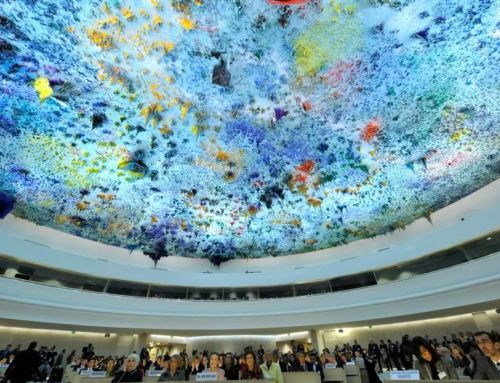
On 9 March 2026, the Human Rights Council held its annual full-day meeting on the rights of the child under the theme: “Rights of the child and violations of the human rights of children in armed conflicts.” The discussion was structured around two panels focusing respectively on prevention and protection, and on reintegration, recovery, remedies and reparation. In total, nine children participated, underscoring the importance of ensuring that when children’s rights are discussed, children themselves – as rights-holders – are meaningfully part of the conversation.
Prevention and protection: addressing root causes and ensuring child participation
Opening the first panel on prevention and protection, Nada Al-Nashif, Deputy High Commissioner for Human Rights, highlighted both the devastating impact of armed conflict and the importance of child participation: “In many contexts, children are not only victims – they contribute to peacebuilding, they promote dialogue, they can help to build bridges and seek common ground.”
A strong and consistent message throughout the panel was that effective prevention requires both addressing the root causes of conflict and systematically integrating children’s rights – and voices – into all stages of policy and response.
Children’s voices were central to these discussions. Yansel, a child advocate from Colombia, emphasised: “Participation is a right, and it truly works because it encourages many children to raise their voices and bring attention to issues that are often seen as adult concerns, but that also deeply affect us.”
Echoing this, Vanessa Frazier stressed: “Wherever children’s futures are discussed, their voices need to be heard.”
Children also put forward concrete, experience-based recommendations. Dariia, from the Child Rights Connect network, highlighted the need for safe, inclusive and trauma-informed spaces: “We hope our recommendations will help ensure that our future is defined not by trauma, but by resilience, dignity, and peace.”
As a representative of Slovenia’s Children’s Parliament reminded participants: “Children do not start wars, yet they suffer the most.”
Overall, the panel underscored that prevention and protection efforts will remain incomplete unless children are recognised not only as beneficiaries, but as partners in shaping solutions.
Reintegration, Recovery and Justice: Moving Beyond Response to Long-term Support
Opening the second panel, Nada Al-Nashif stressed the urgency of strengthening responses to support children affected by conflict: “War is the ultimate violation of a child’s rights… we need to do better.”
The discussions highlighted a critical gap between commitments and reality: while children are entitled to justice, recovery and reintegration, accountability remains limited and resources insufficient. A key takeaway was the need to move beyond short-term responses and invest in long-term, child-centred recovery processes.
Participation again emerged as a central theme. As Nada Al-Nashif underlined: “Children are not only victims. They have a voice in shaping their own lives.”
Children’s contributions reinforced this perspective. Sofiia, from the Lumos Youth Advisory Board in Ukraine, stressed that recovery must go beyond rebuilding infrastructure: “Recovery and reintegration must mean more than rebuilding infrastructure. They must also restore children’s sense of safety, belonging, and opportunity… When children participate in decision-making, policies become more responsive and effective.”
On behalf of the Children’s Advisory Team (CAT) of Child Rights Connect, Sarah called for stronger protection frameworks and meaningful engagement of children in peacebuilding and humanitarian processes: “There should be safe, inclusive, and child-friendly spaces that allow young people to express their views and contribute to policies, peace processes, and humanitarian efforts.”
The panel highlighted that sustainable recovery and justice cannot be achieved without investing in safe participation, psychosocial support, and inclusive systems that respond to children’s lived realities.
You can watch both the morning and afternoon panels on UN Web TV.
Child-led Side Event: A Space for Children to Shape Recommendations for States
A key highlight of the week was the child-led side event, “Our Rights in War: A Child-led Space to Shape Recommendations for States,” organised by children from the Child Rights Connect network.
Bringing together over 120 participants, the event created a unique platform for children to lead discussions and engage directly with decision-makers. Child advocates from diverse contexts – including Ukraine, Palestine, Lebanon and beyond – shared their experiences, with additional contributions from children from Colombia during the interactive discussion, highlighting both the diversity of situations and the strong commonalities in their messages.
The event was moderated by Daria, a youth representative from Ukraine, who opened by drawing attention to the empty chairs of Malak, Layan and Zain – unable to attend in person due to the realities of armed conflict. This powerful moment set the tone for the discussion, grounding it in lived realities.
Throughout the event, children consistently challenged narratives that portray them only as victims, instead positioning themselves as active agents of change.
Yuliia, a 17-year-old advocate from Ukraine, stressed: “I am not here to be seen as a victim. I am here to show you what we are capable of, even when someone tries to destroy our lives.” She further underscored: “A child’s voice is not background noise – it is guidance.”
Zain, a 16-year-old Palestinian advocate, highlighted the importance of translating children’s participation into action: “When children are given the opportunity to express our perspectives, our voices can contribute meaningfully to discussions… but we need decision-makers to turn our recommendations into action.”
From Ukraine, Tetiana shared the realities faced by young people living near the frontline, while also highlighting their agency: “We are children living near the front line. But we are also researchers, advocates, and leaders in our community… when adults trust us and work with us as partners, we become agents of change.”
Malak, from Lebanon, underscored the importance of safe spaces and hope for children affected by conflict: “Children should grow up hearing the sounds of laughter in classrooms and playgrounds, not the sounds of war… protecting those dreams means protecting the future of our whole world.”
Sofiia, from the Lumos Youth Advisory Board in Ukraine, accentuated the importance of partnership and inclusion in decision-making: “If we want to build systems that truly work for children, we must build them together with children, not without them… children are already part of the solutions today.”
Layan, a child advocate from Palestine, highlighted the power of child-led initiatives to both document challenges and propose solutions: “Projects like these create a space where children’s voices, feelings, and creativity can be seen and heard.”
Across these diverse contexts, a set of clear and consistent recommendations emerged. Children called for:
- the meaningful inclusion of children in decision-making processes;
- sustained investment in psychosocial support and safe spaces; and
- the protection of education and access to schools in times of conflict.
These messages were reiterated in the closing of the event, with a strong call for decision-makers to move from listening to action.
Beyond individual testimonies, the event demonstrated the added value of child-led advocacy spaces. By creating an environment where children could speak on their own terms, lead discussions, and interact directly with decision-makers, the event strengthened both the legitimacy and impact of their messages.
The discussions made clear that ensuring children’s participation is not only a right, but a necessity for developing effective responses to armed conflict. Creating and sustaining such spaces remains essential to ensure that children can shape advocacy, policies, and solutions that directly affect their lives.
Creative Advocacy: Art from the Heart
Complementing these powerful testimonies, children’s voices were also expressed through creative means. As part of the side event, Child Rights Connect launched the digital exhibition “Art from the Heart,” further amplifying the messages shared during the discussion.
Developed and led by members of the Children’s Advisory Team, the exhibition brings together 254 artworks and messages created by children from around the world. Through drawings, colours, and words, children share how conflict affects their lives, how they see the world, and what they expect from adults and decision-makers.
Together, the exhibition and the discussions reinforced a common message: children are not only witnesses to conflict, but active contributors to solutions. The exhibition offers a powerful and accessible way to extend the reach of their advocacy, ensuring their voices continue to resonate beyond the room.
A huge thank you goes to all the children and young people who contributed. Their voices and stories are essential – especially in times of war.
Strong Resolution on the Rights of the Child: Realising the Rights of the Child Affected by Armed Conflict
The Council adopted its biennial resolution on the rights of the child by consensus with a very strong text setting out strengthened measures to prevent and respond to grave violations against children in armed conflict, with a clear focus on accountability, protection, and child-centred recovery. Two hostile amendments tabled by Russia were not supported, reflecting broad support for protecting children’s rights.
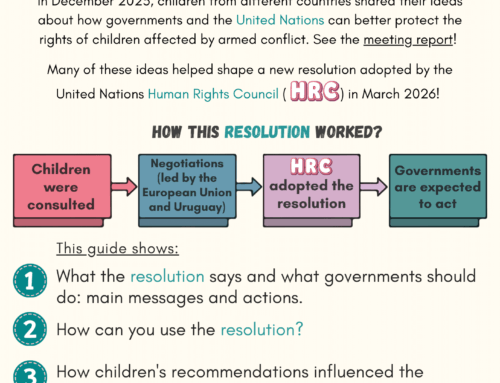
This outcome reflects sustained and strategic advocacy efforts led by the Child Rights Connect Working Group on Children and Armed Conflict. Since December 2025, the Working Group has actively engaged in the resolution process— submitting inputs to the penholders and organising a dedicated online consultation with children from conflict-affected contexts to ensure their perspectives were meaningfully reflected.
The resolution incorporates recommendations shared directly by children during the December online consultation, ensuring their voices and experiences helped shape the outcome. A separate analysis of the wins in the resolution and the influence of children’s recommendations will be made available.
At a time of growing global challenges, these results show the importance of coordinated advocacy and meaningful child participation in shaping international human rights standards.
Looking ahead, this momentum must be maintained beyond the Council session. Advocacy efforts should continue throughout the year, especially as this year marks the 30th anniversary of the establishment of the UN mandate on children and armed conflict, to ensure that commitments made at the international level translate into concrete change in children’s lives.